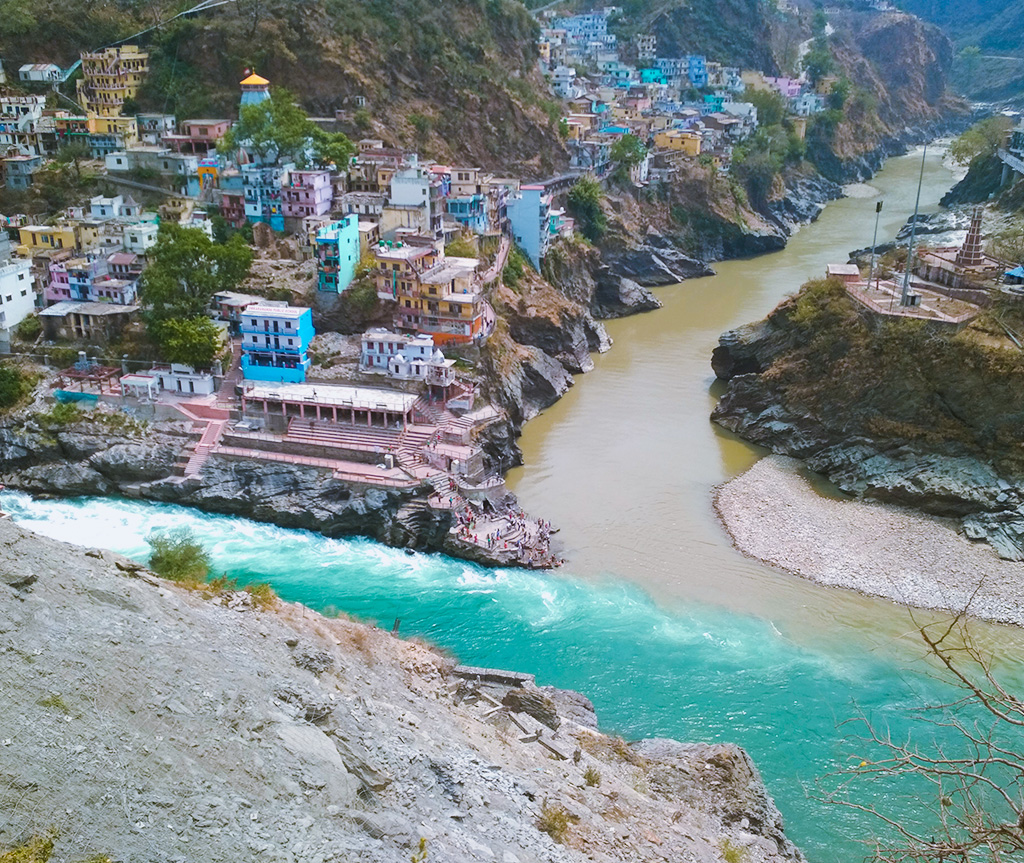
Nestled in the heart of the Garhwal Himalayas, the Panch Prayag—comprising Vishnuprayag, Nandaprayag, Karnaprayag, Rudraprayag, and Devprayag—represent the five sacred river confluences of Uttarakhand. These sites hold immense spiritual significance in Hinduism, marking the points where the Alaknanda River merges with its tributaries before becoming the revered Ganga at Devprayag.
What is Panch Prayag?
In Sanskrit, “Prayag” means “confluence,” and “Panch” denotes “five.” Thus, Panch Prayag refers to the five sacred river confluences in Uttarakhand. These sites are not only geographical marvels but also hold deep religious importance, often visited during the Char Dham Yatra and other spiritual journeys.
The Five Sacred Confluences
1. Vishnuprayag – The First Sacred Confluence
Vishnuprayag is the first of the Panch Prayag (five holy confluences) in the Garhwal Himalayas. This spiritually significant site marks the confluence of the Alaknanda River and the Dhauliganga River.
Location:
- Near Joshimath, in the Chamoli district of Uttarakhand
- Situated at an altitude of approximately 1,372 meters (4,500 ft)
Rivers Converging:
- Alaknanda River (major tributary of the Ganga)
- Dhauliganga River (originating from the Niti Valley near the Indo-Tibetan border)
Spiritual & Mythological Significance:
- Named after Lord Vishnu, who is believed to have appeared here before Sage Narada during his penance.
- The site represents divine blessings and spiritual elevation, making it an essential stop for pilgrims heading to Badrinath Dham.
- The Vishnuprayag Temple, dedicated to Lord Vishnu, stands close to the confluence and is an important religious attraction.
Tourist Highlights:
2. Nandaprayag – The Second Sacred Confluence
Nandaprayag is the second confluence among the revered Panch Prayag in Uttarakhand. It is the meeting point of the Alaknanda River and the Nandakini River, surrounded by serene Himalayan landscapes and spiritual tranquility.
Location:
- Located in Chamoli district, Uttarakhand
- Positioned at an altitude of around 914 meters (3,000 ft)
Rivers Converging:
- Alaknanda River (main river heading toward Devprayag)
- Nandakini River (originates from the glaciers below Trishul Peak)
Religious and Mythological Importance:
- The name “Nandaprayag” comes from King Nanda, the foster father of Lord Krishna.
- According to legend, King Nanda performed a great yajna (ritual) here to be blessed with a divine child.
- The confluence is believed to radiate purity, grace, and devotion, making it a revered spot for pilgrims.
Spiritual Attractions:
- Nand Temple near the confluence, dedicated to King Nanda
- Ghats for ritual bathing and offerings to ancestors
- A peaceful alternative to more crowded confluence sites
3. Karnaprayag – The Third Sacred Confluence
Karnaprayag is the third of the revered Panch Prayag of the Alaknanda River in Uttarakhand. It marks the divine confluence of the Alaknanda River and the Pindar River, and is steeped in tales of valor, devotion, and celestial blessings from the Mahabharata era.
Location:
- Situated in Chamoli district, Uttarakhand
- Located at an altitude of about 788 meters (2,585 ft) above sea level
Rivers Converging:
- Alaknanda River – one of the two main headstreams of the Ganga
- Pindar River – originates from the Pindari Glacier in the Kumaon Himalayas
Religious and Mythological Significance:
- Named after Karna, the great warrior from the Mahabharata.
- It is believed that Karna meditated here and was blessed by Lord Parashurama with divine armor and weapons.
- According to legends, Karna also performed penance here to attain immortality and strength.
- The site symbolizes courage, sacrifice, and spiritual dedication.
Spiritual & Historical Attractions:
- Karna Temple near the riverbank, believed to be built in his memory
- Riverside ghats for ritual bathing and spiritual ceremonies
- A cultural mix of pilgrimage and daily life in a traditional Himalayan town
4. Rudraprayag – The Fourth Sacred Confluence
Rudraprayag is the fourth of the revered Panch Prayag where the sacred Alaknanda River meets the Mandakini River, creating a spiritually charged confluence. It is one of the most significant pilgrimage stops en route to Kedarnath Dham, and is associated deeply with Lord Shiva in his fierce Rudra avatar.
Location:
- Located in Rudraprayag district, Uttarakhand
- Altitude: Approximately 610 meters (2,000 ft)
Rivers Converging:
- Alaknanda River – continues its journey from Badrinath
- Mandakini River – originates from the Chorabari Glacier near Kedarnath
Mythological & Spiritual Significance:
- Named after Lord Rudra, a fierce form of Lord Shiva.
- It is believed that Shiva performed the Tandava Nritya (cosmic dance) here.
- Legends state that Narada Muni meditated here to learn music, and Lord Shiva blessed him.
- The confluence symbolizes the union of divine energy and destruction of ignorance.
Spiritual Attractions:
- Rudranath Temple: Dedicated to Lord Shiva, located at the sangam point
- Koteshwar Mahadev Cave Temple: A revered cave shrine on the banks of the Alaknanda
- Dhari Devi Temple (nearby): Another powerful Shakti Peeth often visited by pilgrims
5. Devprayag – The Final and Holiest Confluence
Devprayag is the fifth and most sacred of the Panch Prayag (five confluences) of Uttarakhand. It is here that the Alaknanda River, after merging with several tributaries upstream, finally unites with the Bhagirathi River, marking the official beginning of the holy River Ganga (Ganges).
Location:
- Situated in Tehri Garhwal district, Uttarakhand
- Altitude: Around 830 meters (2,723 ft) above sea level
Rivers Converging:
- Bhagirathi River – originates from the Gangotri Glacier
- Alaknanda River – formed by contributions from the other four Prayags
Religious and Mythological Significance:
- “Devprayag” translates to “Godly Confluence“, and is considered the spiritual birthplace of the Ganga.
- According to Hindu mythology, Lord Rama performed penance here to atone for Brahmahatya (sin of killing Ravana, a Brahmin).
- The ancient town has been a seat of Vedic learning and rituals for millennia.
- Devprayag is home to priests of Badrinath Dham known as Pandas of Devprayag.
Spiritual Attractions:
- Raghunathji Temple: A 10,000-year-old temple dedicated to Lord Rama
- Sangam Point: Clear visual distinction of green Alaknanda and silt-laden Bhagirathi
- Brahma Kund: Sacred spot for ritual bathing and performing Shraddha rites
Tourist Highlights:
- Panoramic views of the merging rivers, temples, and Himalayan hills
- Vibrant spiritual energy enhanced by ringing temple bells and river chants
- A peaceful town ideal for pilgrimage, meditation, and cultural immersion
Travel Tips:
- Best time to visit: September to April (avoid monsoon)
- How to reach:
- ~90 km from Rishikesh via NH58
- Accessible by car, bus, and shared taxis
- Nearest railhead: Rishikesh (via Yog Nagri Rishikesh Railway Station)
- Ideal for: Pilgrims, spiritual seekers, and heritage enthusiasts
- Spiritual Significance of Panch Prayag
The Panch Prayag sites are integral to Hindu spirituality:
Purification: Bathing at these confluences is believed to cleanse sins and aid in attaining moksha (liberation).
- Rituals: Common sites for performing ancestral rites (Shraddha) and other Vedic ceremonies.
- Pilgrimage: Often included in the Char Dham Yatra, enhancing the spiritual journey.
Travel Guide for Panch Prayag Yatra
- Best Time to Visit: April to June and September to November for pleasant weather.
- Accessibility: All five sites are accessible via the Rishikesh-Badrinath highway.
- Distances from Rishikesh:
- Devprayag: ~70 km
- Rudraprayag: ~140 km
- Karnaprayag: ~169 km
- Nandaprayag: ~190 km
- Vishnuprayag: ~256 km
Tips for Pilgrims
- Health Precautions: Carry necessary medications and acclimatize to higher altitudes gradually.
- Local Customs: Respect local traditions and dress modestly.
- Sustainable Travel: Avoid littering and use eco-friendly products to preserve the sanctity of these sites.
Conclusion
Embarking on the Panch Prayag Yatra offers a profound spiritual experience, connecting devotees with the divine essence of the Himalayas. Each confluence holds unique significance, weaving together mythology, devotion, and natural beauty.